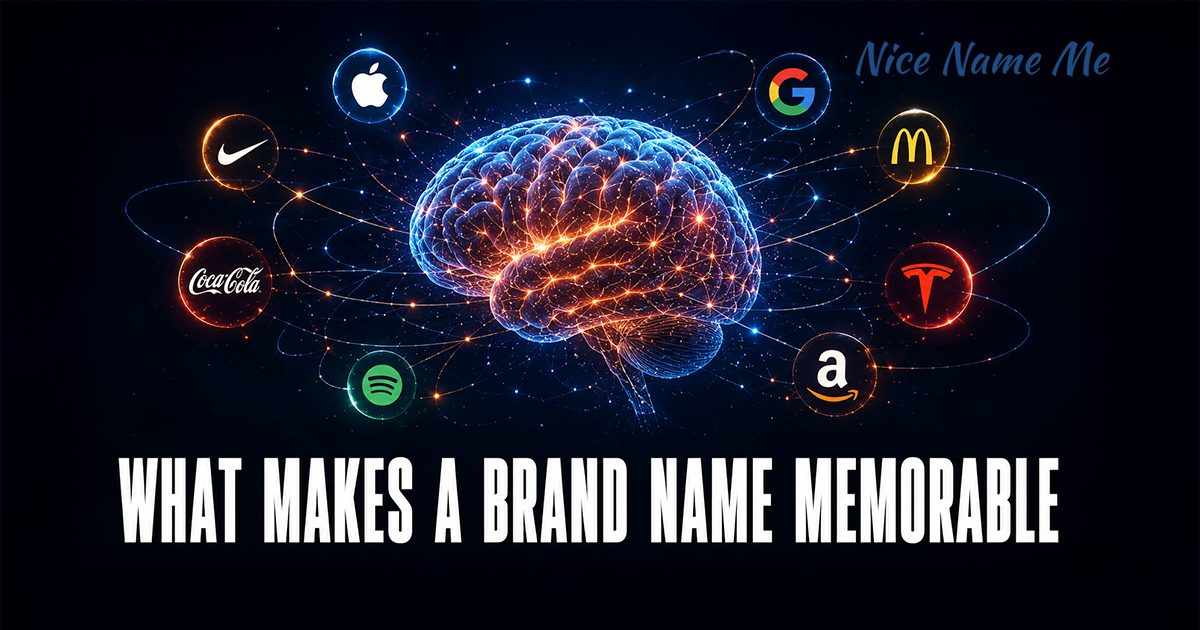
Google's name was almost "Googol." The misspelling survived because it was easier to type, easier to say, and — as it turned out — easier to remember. That accident contains everything you need to know about memorable brand names: phonetics beat precision, and memory beats logic every time.
Most founders approach naming like a labeling exercise. Find a word that describes the product. Add a modifier if the obvious domain is taken. Register whatever's available and move on. The result is a name that explains the business to no one and sticks in no one's memory. Meanwhile, founders who understand how memory actually works build names that spread without advertising budgets.
Sound Structure Determines Whether a Name Survives First Contact
Before anyone can remember your brand name, they have to be able to say it. This sounds obvious. It eliminates roughly 40% of startup names currently in production.
The names that survive are short, rhythmic, and phonetically distinctive. One or two syllables. A clear stress pattern. At least one sound that stands out without being unpronounceable. Zoom. Slack. Stripe. Each clears all three bars.
Hard consonants — K, P, T — create stronger memory anchors than soft sounds. Kodak, PayPal, TikTok. The brain processes crisp consonants faster, which means the name leaves a sharper trace. Names heavy on L's and M's tend to blur together in memory, which is why your competitors with names like "Lumera" and "Melora" keep getting confused with each other at conferences.
Take NoAge.ai — two syllables, a contradiction built in, and a clear vertical (beauty, wellness, longevity).
That built-in tension does real work. The name doesn't just label a product — it creates a small cognitive event. The brain pays more attention to things that require a second look. More attention means stronger memory encoding.
Pattern Recognition Is a Memory Cheat Code
Human memory is not a filing cabinet. It's a pattern-matching system that stores information by connecting it to things already known. Brand names that exploit this architecture get remembered faster and retained longer than names that fight it.
Alliteration works because it creates instant pattern recognition — PayPal, Best Buy, Range Rover. Rhyme and near-rhyme tap the same mechanism: FedEx, LinkedIn, YouTube. These aren't stylistic choices. They're memory engineering.
The most powerful naming pattern is the portmanteau — two familiar words fused into something new. Microsoft (microcomputer + software). Netflix (internet + flicks). Instagram (instant + telegram). Your brain decodes the meaning immediately, but the combination is novel enough to register as something worth storing. Familiar territory, unexpected discovery. Memory loves that combination.
If you're working through the mechanics of applying this to a real name, the startup naming guide walks through pattern-based naming with examples from funded companies that got this right — and a few that didn't.
Emotional Encoding Bypasses the Brain's Delete Button
The brain filters out enormous amounts of information every day. What survives is information that carries emotional weight — because historically, emotionally significant events were the ones most likely to affect survival.
Brand names that trigger emotional responses get routed into long-term memory faster than neutral names. The emotion doesn't have to be intense. It just has to register.
Consider the different emotional registers that high-retention names work in:
- Aspiration: Nike (Greek goddess of victory), Oracle (divine knowledge) — names that make the buyer feel like they're accessing something elevated
- Comfort: Nest, Spotify, Slack — names that lower the emotional stakes of the category
- Energy: Zoom, Rocket, Bolt — names that transfer kinetic momentum to the product
- Curiosity: Palantir, Reddit, Figma — names that create a small information gap the brain wants to close
Mild cognitive dissonance works too. In 1976, Apple Computer violated every naming convention in its category. Serious technology companies had serious names — International Business Machines, Digital Equipment Corporation. A piece of fruit created cognitive friction that made the name impossible to ignore. The double-take is a memory event. Sometimes the most memorable brand name is the one that makes people stop and reconsider what they just heard.
Searchability Is Now Part of Phonetics
A generation ago, a name's acoustic properties mattered at trade shows and in phone conversations. Now they matter across voice search, autocomplete, and social handle availability — and the stakes on each have increased.
Names that work in voice search ("Hey Siri, open Stripe") and survive autocorrect ("Netflix," not "Netflik") get used more often. Each successful use strengthens the memory trace. Names that introduce friction at the technology layer reduce repetition, and reduced repetition means slower memory consolidation for everyone who encounters the brand.
This is why single-word .com domains still command significant premiums despite two decades of new TLD options — the typing, speaking, and searching experience is frictionless in ways that compound over time. When you're evaluating name candidates, test them in voice search before you fall in love with any of them. If the assistant mishears it twice, your customers will mishear it too.
When you've landed on candidates worth testing, registering exploratory domains through Dynadot is a low-cost way to hold options while you gather real-world feedback. The names that come back to you in conversations — the ones people repeat correctly without being coached — are the ones building genuine memory architecture.
Word-of-Mouth Is a Memory Multiplier
Every time someone successfully recommends your brand to another person, two things happen: the recommender's memory of the name strengthens, and a new memory trace is created in someone else's brain. A memorable name spreads because it's memorable, then becomes more memorable because it spreads. A forgettable name breaks the chain at the first transmission.
The test is simple: when someone recommends "that new project management tool," are they more likely to remember and correctly transmit "Asana" or "Comprehensive Workplace Task Coordination Platform"? Every failed transmission is lost market reach with no acquisition cost attached — you just didn't get it.
Names that are easy to say, easy to spell, and tied to a clear visual concept survive transmission most reliably. Dropbox. Shopify. Canva. Each of these names carries its core brand concept through third-party description without requiring the original marketing materials. The name does distribution work that no ad budget can replicate.
What Actually Separates Memorable From Forgettable
The insight isn't that memorable names follow rules — it's that they exploit the actual mechanics of memory rather than the mechanics of logic. Logical names explain products. Memorable names create cognitive events: a phonetic hook, a pattern surprise, an emotional register, a small moment of friction or delight that tells the brain this is worth storing.
Zoom doesn't explain video conferencing. Stripe doesn't explain payment processing. Figma doesn't explain collaborative design. Each name creates an experience before the product does — and that experience is what memory consolidates.
Test your candidates against these five properties: two syllables or fewer, at least one hard consonant, a recognizable pattern (alliteration, rhyme, portmanteau), a clear emotional register, and clean searchability. Names that clear four of five will outperform names built on descriptive logic almost every time. Browse existing candidates in our domain marketplace to see how these properties appear in names that have already survived curation.
Find Your Perfect Domain
Free three-tier appraisal — quick sale, realistic market, ideal buyer. No guesswork.
Try Free Appraisal Browse Premium Domains