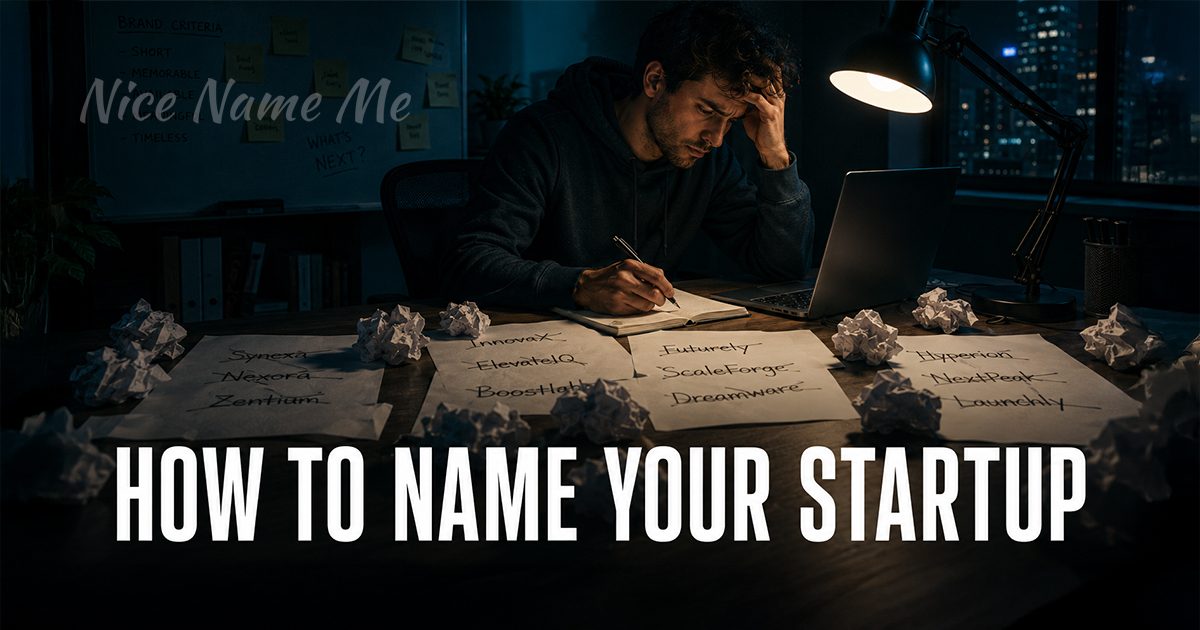
Founders spend an average of 40 hours choosing their tech stack and fewer than 4 hours choosing their company name. Then they spend the next five years explaining to customers how to spell it.
The naming problem isn't creativity. It's sequencing. Most founders brainstorm first and apply constraints second, which means they fall in love with names that are trademarked, have no available domain, or sound identical to a competitor three categories over. The founders who get this right work in the opposite order: constraints first, creativity inside those constraints.
Define Your Strategic Position Before You Brainstorm Anything
Write your startup's core promise in one sentence. Not your mission statement — your promise. What does the customer get that they couldn't easily get elsewhere? That sentence determines whether your name should be descriptive, abstract, or invented.
Descriptive names like QuickBooks or General Motors trade memorability for immediate clarity. That's often the right trade for B2B products where buyers need to understand you before they'll talk to you. Abstract names like Spotify or Apple require marketing budget to build meaning, but they don't box you in when your product evolves.
Your competitive landscape matters here more than most naming guides admit. If every fintech company in your space ends in -ly or -fy, that suffix now signals "another fintech company" rather than "this specific company." Deliberate pattern-breaking is a strategic move, not a creative preference. Study the naming conventions in your category, then go somewhere different.
Consider your expansion path from the start. Amazon worked because it didn't say "books." Confinity had to become PayPal when the product outgrew its original focus. If you can see a version of your business that's meaningfully different from the launch product, choose a name that won't require rebranding to accommodate it.
The Four Name Types That Hold Up Over Time
Not all naming approaches suit all startups. The right type depends on your category, funding, and how much you need a name to do your early marketing work.
- Descriptive names — tell customers what you do (QuickBooks, YouTube). High clarity, lower memorability. Best for complex B2B products where confusion has a cost.
- Brandable names — distinctive sounds without literal meaning (Spotify, Slack). Require marketing investment to build associations, but offer flexibility as your product changes. Two syllables, easy spelling, no awkward consonant clusters.
- Compound names — two familiar words merged into something new (Facebook, Snapchat). Often yield available domains at reasonable prices, which matters when single-word .com domains routinely sell for six figures.
- Invented names — new words entirely (Kodak, Xerox, Google). Maximum trademark protection and guaranteed domain availability at registration price. The tradeoff is that you're building meaning from zero, which requires serious marketing budget.
The characteristics that make brand names memorable cut across all four types: short enough to say in one breath, phonetically distinct from competitors, and easy to spell after hearing it once. A name that fails the "say it in a phone call" test fails in the real world regardless of how good it looks on a slide deck.
The Domain Reality Check (Run This Earlier Than You Think)
Premium single-word .com domains now sell for $10,000 to $1 million depending on the word. That's not a negotiating position — that's the market. Which means domain availability needs to enter your process before you get attached to anything.
Check domain availability for every name on your shortlist before presenting options to anyone. This takes three minutes and eliminates half your list for free. The names that survive that filter are the ones worth developing further.
Compound words, invented names, and brandable two-word phrases often remain available at registration price — around $10–15 per year. That's where the practical opportunity is. Airbnb shortened AirBedAndBreakfast.com not just for aesthetic reasons, but because shorter names are easier to type, easier to say in conversation, and easier to own at scale. A name like Motoro.ai is a useful illustration of the principle: it suggests movement and technology without spelling either out, and it cleared availability at a fraction of what a dictionary word in that category would cost.
If you're considering a .ai, .io, or .co extension instead of .com, understand what you're trading. These extensions signal certain things to certain audiences — .ai carries genuine credibility in the AI space right now — but they carry costs too. Investors who write checks to U.S. companies still default to .com as the signal of a "real" business. You can build on alternative extensions successfully, but go in with clear eyes about the tradeoffs rather than choosing them by default because .com wasn't available.
International considerations matter more than most founders anticipate. A name that works in English might be a slur in Portuguese or unpronounceable in Mandarin. A quick Google Translate check takes ten minutes and has saved companies from expensive rebranding when they expanded faster than expected.
Trademark Clearance Is Not Optional
The USPTO database is free to search. Use it before you print anything. A trademark conflict doesn't always mean someone sues you immediately — sometimes it means a cease-and-desist arrives two years in, after you've built brand equity, printed packaging, and run ads. That's when the rebranding costs become genuinely painful.
Search your exact name in your category and in adjacent categories. A name that clears in software might conflict in financial services. If you're operating in a regulated industry, add an attorney to this step. A professional trademark search costs a few hundred dollars. A trademark lawsuit costs considerably more.
A domain appraisal can also surface potential conflicts you might not think to check — particularly if a premium domain with your name is already held by a business operating in your space. Knowing this early changes your decision; finding out later changes your business.
Test Your Short List in the Real World
Conference room opinions are the least reliable signal you can gather. Print your top three names on a piece of paper and show them to ten people outside your company. Can they spell the name back after hearing it once? Do they remember it correctly five minutes later? What do they assume the company does?
Say each name out loud in a sentence. "I work at ___." "Check out ___." "We just signed with ___." Names that feel awkward in those frames will feel awkward in every sales call, podcast mention, and word-of-mouth referral your company generates. The naming mistakes that hurt startups most often come down to skipping this step — founders so close to a name they can't hear it the way a stranger hears it for the first time.
Test it in every context where customers will encounter it: email signature, podcast ad read, billboard, Google search result. Names that work in one format often fail in others. A name with ambiguous spelling reads fine in print and becomes a support ticket every time someone tries to find you through voice search.
When Your Name Is Good Enough, Stop
The perfect startup name doesn't exist. The right name for your specific situation, budget, and timeline does exist, and it's usually the one you can actually secure, trademark, and build on — not the one you'd have if the .com were available for $12.
If you're building a SaaS product, the specific dynamics around product naming and category positioning are worth thinking through separately — the considerations for naming a SaaS product differ from consumer brands in ways that affect which name type you should reach for first.
Your name creates the frame. What you build inside that frame determines whether anyone cares about it. Run the process systematically, eliminate the options that fail the real constraints, and then commit to whatever survives. Consistency of execution builds brand recognition faster than naming brilliance.
A name like Motoro.ai works because it suggests movement and technology without spelling either out.
Find Your Perfect Domain
Free three-tier appraisal — quick sale, realistic market, ideal buyer. No guesswork.
Try Free Appraisal Browse Premium Domains