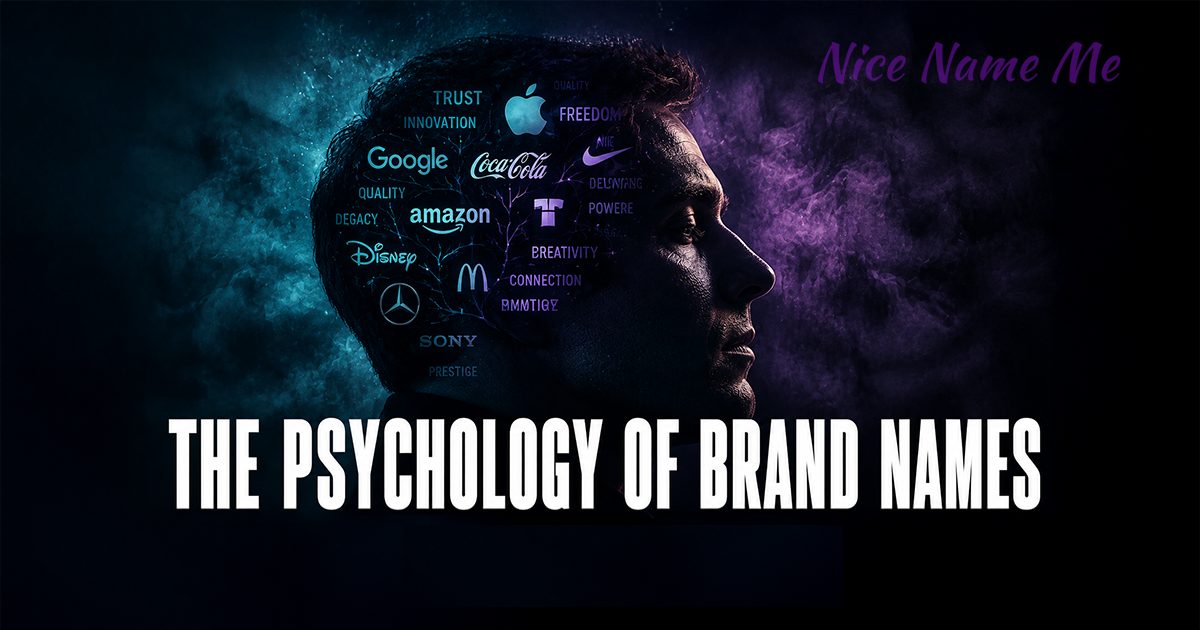
Your brain decides whether a name feels trustworthy or forgettable within 400 milliseconds — before you've consciously processed a single syllable. That's not a metaphor. It's the speed at which pattern recognition, emotional association, and phonetic evaluation happen in parallel. Founders who understand this build names that customers remember without trying. Founders who ignore it spend money on marketing that fights an uphill battle the name itself created.
The Cognitive Load Factor
Complex names create friction. Not conceptual friction — actual processing delay that the brain interprets as distrust.
This is the fluency effect in action: names that are easier to process feel more credible. When someone can pronounce your name confidently on first sight, they unconsciously associate that ease with your competence. Stripe is visual and immediate. Zoom is one syllable with no ambiguity. These names don't require effort, and that effortlessness becomes part of their brand equity.
Squarespace is 11 characters and three syllables — technically complex — yet it works because both component words are instantly familiar. The brain processes known elements quickly even in new combinations. The lesson isn't "always go short." It's "never make someone work to decode you."
Spelling traps are a specific version of this problem. If your name requires a correction every time someone searches for it, you're paying a cognitive tax on every word-of-mouth referral you earn. Avoidable friction is the most expensive kind.
A name like SynthTech.ai activates synthesis + technology associations simultaneously — two concepts, one word.
Emotional Anchoring Happens Before Rational Evaluation
Names trigger emotional responses roughly 200 milliseconds before conscious analysis begins. You feel something about a name before you think about it. Founders who understand this stop asking "does this name describe what we do?" and start asking "what does this name make someone feel?"
Discord chose a name that suggests controlled chaos — intentional friction that appealed to gamers who see competitive disruption as identity. Notion picked a broad, aspirational term that feels limitless, inviting users to project their own meaning onto it. Neither name describes a feature. Both names communicate a relationship.
Sound symbolism operates below conscious awareness and shapes perception without anyone realizing it:
- Hard consonants (K, T, P) suggest strength, speed, and decisiveness
- Soft sounds (L, M, N, W) read as approachable, warm, and friendly
- Vowel repetition creates memorability — "Google" works partly because of its doubled vowel pattern
- Plosive endings feel definitive; names ending in open vowels feel expansive
Airbnb shortened from AirBedAndBreakfast.com in 2009 not because the concept changed but because the original felt amateur. The phonetic tightening signaled professionalism the product had earned. The mere exposure effect means customers develop preference through familiarity, but you need positive emotional anchoring from first contact — not after 15 touchpoints have corrected the wrong first impression.
How Memory Actually Retains Brand Names
Descriptive names disappear. "Digital Solutions Inc" fails because it matches too many existing memory patterns — it activates recognition of a category without creating a distinctive trace. The brain files it as "another one of those" and moves on.
Distinctive names survive because distinctiveness forces the brain to create a new memory structure rather than slotting the name into an existing one. Apple works across decades partly because fruit has nothing to do with computers. That semantic gap — the mild cognitive surprise of a mismatch — creates a stronger memory trace than any amount of descriptive accuracy could.
Twitter (originally Twttr) succeeded as a name because it gave users a mental model. The metaphor of brief, bird-like communication told a mini-story that oriented new users before they'd read a word of copy. Names that engage narrative processing reach more neural pathways than names that simply describe.
The spacing effect in memory research shows that information requiring slight cognitive engagement sticks longer than instantly obvious information. Slack's backronym — Searchable Log of All Conversation and Knowledge — created just enough complexity to be memorable without tipping into confusion. The name rewarded investigation, which made it more memorable to the people who looked it up.
If you're auditing names against these criteria, the guide on what makes a brand name memorable runs through the structural elements in more detail.
Cultural Context and the Limits of Local Intuition
Names carry cultural baggage that varies by geography, generation, and social context. What registers as innovative in one market can read as aggressive, meaningless, or worse in another. Chevrolet's Nova famously struggled in Spanish-speaking markets because "no va" means "doesn't go" — a branding problem that could have been caught with basic localization research.
Kodak was engineered from scratch to be pronounceable across major world languages while avoiding negative associations in any of them. That kind of deliberate construction is expensive, but expensive rebranding after international expansion is more so.
Invented words sidestep translation problems by bringing no prior meaning to any market. Häagen-Dazs is invented — it means nothing in any language — but it sounds vaguely European and premium, which aligned with the brand positioning. The name created its own cultural context rather than borrowing from an existing one.
Generational preferences also shift naming conventions faster than most founders expect. The aesthetic that reads as authentic to one cohort can read as try-hard to the next. If your primary customer is 24 years old today, their naming preferences will matter more than any demographic study from three years ago. Test with real people from your actual target market, not just colleagues who share your cultural reference points.
Domain Availability and the Psychology of Compromise
Domain pressure has pushed founders toward creative spelling, hyphens, and unexpected TLDs. Some of these decisions are strategically sound. Many create psychological problems the founders don't discover until they're explaining their email address on a podcast.
The core tension: a name that's psychologically optimal but unavailable as a .com forces a choice between the name and the real estate. This is worth thinking through carefully before committing. A strong name on a .ai or .co domain, priced right and positioned well, outperforms a weak name on a perfect .com. But a strong name on a confusing or unmemorable domain creates ongoing friction.
The common mistakes founders make when trying to solve this problem are documented in detail in the startup naming mistakes article — particularly the ones that feel like clever solutions in the moment and reveal themselves as problems at scale.
Check domain availability early, before you fall in love with a name. Dynadot's registrar at Dynadot.com lets you search extensions simultaneously, which makes the available-versus-ideal tradeoff visible before you've built an attachment. For premium domains that already carry positive phonetic and associative qualities, the domain store is worth reviewing — some of the psychological work is already done.
Applying the Psychology Without Overthinking It
The research on brand name psychology can become a trap. Founders who run every candidate name through fluency analysis, phonosemantics, and cultural screening often end up in analysis paralysis, cycling through options that all look roughly equivalent after enough scrutiny.
A more practical approach: eliminate names that fail obvious tests (hard to spell, easy to mishear, negative associations in key markets), then run two or three finalists through your actual target customers. Real reactions from real people outperform theoretical frameworks every time.
The names that endure — the ones that feel inevitable once you've heard them — usually succeed because they got the basics right: easy to say, distinctive enough to remember, emotionally resonant with the right audience, and available on a domain that doesn't undermine the first impression the name creates. For a structured walkthrough of the decision process, the startup naming guide covers each step in sequence.
The psychology is consistent. Your application of it should be specific to what you're building, who you're building it for, and what you need them to feel the first time they hear your name.
Find Your Perfect Domain
Free three-tier appraisal — quick sale, realistic market, ideal buyer. No guesswork.
Try Free Appraisal Browse Premium Domains