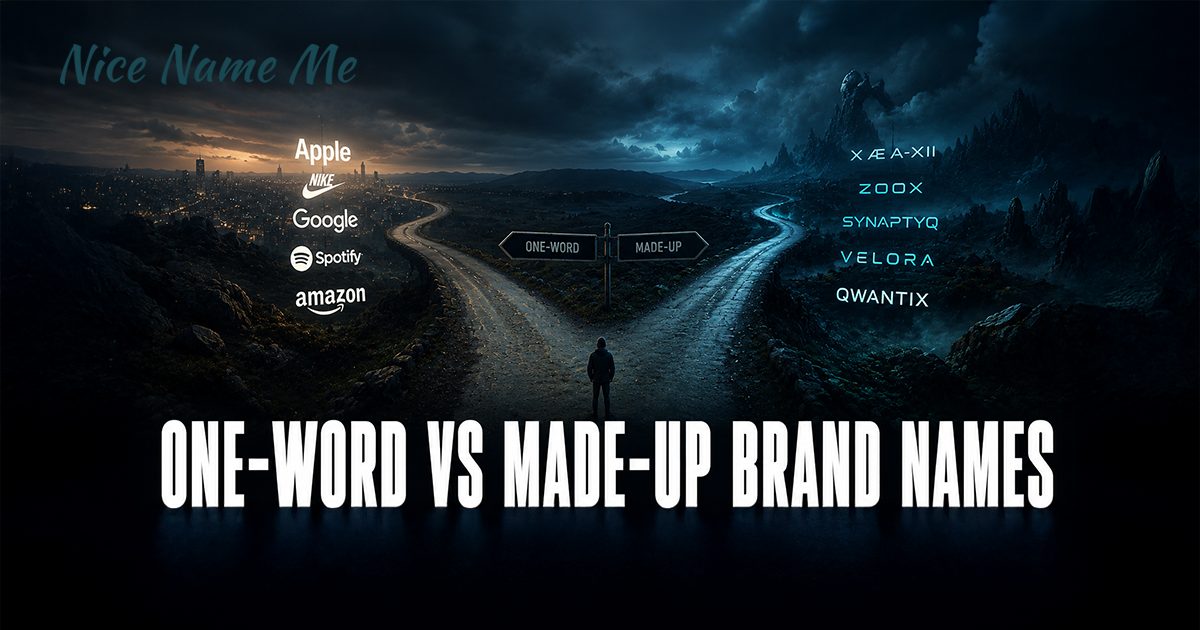
Voice.com sold for $30 million in 2019. The same year, a founder registered a made-up .com for $12 and built a company now worth $400 million. Both naming strategies work — they just work differently, and for different founders at different stages.
The real word versus invented word debate dominates startup naming discussions for good reason. The choice affects your domain budget, trademark position, marketing spend, and how fast customers understand what you actually do. Getting this wrong early is expensive. Not because you'll fail, but because reversing a bad naming decision costs more than making the right call upfront.
What "Real Word" Actually Means in Naming Strategy
Dictionary words deliver comprehension that invented names cannot replicate on first contact. When someone hears "Stripe" or "Notion," they arrive with pre-loaded associations — smooth transactions, organized thinking — before reading a single line of copy. That cognitive shortcut is genuinely valuable.
But "real word" is not a monolithic category. There's a meaningful difference between descriptive words ("Analytics," "Marketing") and evocative words ("Apple," "Slack," "Buffer"). Descriptive words face an almost impossible trademark burden — you're trying to own language that competitors have a legitimate right to use. Evocative words sidestep this problem entirely. Apple had zero connection to computers in 1976. That gap between word meaning and industry function is what made the trademark defensible.
The domain math is brutal regardless of which real-word category you're in. Single dictionary .com domains now floor at $50,000 for obscure words. Common nouns run five to six figures. Game.com went for $1.2 million. If your naming strategy requires owning a dictionary word as a .com, budget accordingly before you fall in love with the name. Tools like Dynadot let you check availability quickly, but availability on premium real-word domains is almost always the same answer: taken, and expensive to acquire.
The Invented Word Case Is Stronger Than You Think
Fanciful marks — completely invented words with no prior meaning — receive the strongest possible trademark classification. Kodak, Xerox, Häagen-Dazs. No competitor can claim descriptive necessity. No prior use argument applies. You own the word within your business categories from day one.
The domain situation flips entirely. A carefully constructed invented word typically registers as a .com for standard fees. The obstacle shifts from affordability to memorability: can you create something pronounceable, spellable, and sticky enough to survive without the crutch of existing meaning?
This is where most founders underestimate the challenge. Xerox spent decades and tens of millions transforming a meaningless syllable string into a verb. Google had the advantage of a genuinely interesting and slightly absurd sound — "googol" the mathematical term gave it just enough referential hook to spread early. Most startups launching invented names today have neither Xerox's budget nor Google's timing advantage.
The invented names that work without massive spend tend to share one trait: the meaning is recoverable. The word sounds like what it does, or it combines recognizable parts in a new way. Which brings us to the category that often outperforms both pure strategies.
The Compound Middle Ground
The most underrated naming approach isn't choosing between real words and invented words — it's constructing invented compounds that carry transparent meaning. Words built from recognizable parts that don't exist as standalone dictionary entries.
Fraudless.ai is a good example of a made-up compound that works — the meaning is instant, the promise is built in.
"Fraudless" doesn't appear in Merriam-Webster. But no one needs it explained. The compound delivers the real word advantage — instant comprehension — while preserving the trademark and domain advantages of invented language. You're not competing with prior registrations. You're not paying $200,000 for a dictionary word. And you're not asking customers to learn a sound from scratch.
Successful examples of this pattern are everywhere once you look: Salesforce, Shopify, HubSpot, Cloudflare. None are dictionary words. All are immediately parseable. This approach is particularly strong for B2B software, where describing the function clearly matters more than sounding mysterious. For a deeper look at what structural features make names stick, the analysis of what makes brand names memorable is worth reading before you finalize anything.
The Budget and Stage Question
Naming strategy is also resource allocation strategy. The right choice depends heavily on what you can actually spend — on the domain, on brand education, and on trademark defense.
Pre-seed and seed stage: Real single-word .com domains are almost certainly out of reach at fair prices. Competing for them against domain investors with seven-figure portfolios is a bad use of limited capital. Invented compounds on .com, or strong brandables on .ai or .io, give you defensible trademark ground and affordable acquisition costs. For reference, quality two-word .ai brandables now trade between $3,000–$15,000 in the secondary market — a fraction of equivalent .com real-word pricing. Browsing what's currently available gives you a realistic sense of the range before you set expectations.
Series A and beyond: If you've validated the business and raised meaningful capital, the calculus changes. A strong real-word .com acquisition becomes a legitimate brand asset rather than a vanity expense. The comprehension advantage compounds as you scale paid acquisition — lower CPC friction, higher recall rates, better word-of-mouth propagation.
International expansion: English real words carry translation risk. "Gift" means poison in German. "Nova" means "doesn't go" in some Spanish-speaking markets. Invented words sidestep this entirely, which is one reason global-first companies disproportionately favor fanciful marks. If you're building for multiple markets from launch, this factor should weigh heavily in your decision. The full startup naming strategy guide covers international considerations in more detail.
Trademark Reality Check
Neither strategy automatically wins at the trademark office. What matters is distinctiveness within your specific goods and services class.
A real word can be highly distinctive if it has no logical connection to your industry — Apple for computers, Amazon for e-commerce. The same word becomes nearly unregistrable if it describes your product directly. "Analytics" for analytics software is a non-starter. "Analytics" for artisanal candles is defensible.
Invented words start with an advantage in distinctiveness, but made-up words that sound too similar to existing marks still face opposition. "Googal" would have faced challenges from Google regardless of its invented status. Phonetic similarity, not just spelling, matters to examiners and to courts.
Before committing to any name — real or invented — run a trademark search across relevant classes in every market you plan to operate. This is not optional due diligence. A naming conflict discovered post-launch, after business cards, domain costs, and marketing spend, costs orders of magnitude more to fix than a $300 search costs upfront.
How to Actually Decide
The honest answer is that both strategies produce iconic brands and failed companies in roughly equal measure. What matters is the fit between your strategy and your constraints.
If you have limited marketing budget and need fast customer comprehension, a strong evocative real word or transparent compound beats a fanciful invented name you'll spend years explaining. If you're well-capitalized, building globally, and want maximum trademark strength, a carefully crafted fanciful mark with a clean .com has real advantages worth the brand-education investment.
What doesn't work: defaulting to an invented name because you can't afford the real word you actually want, then discovering the invented name is phonetically awkward, hard to spell, and impossible to explain over the phone. That's not a branding strategy. That's a budget constraint dressed up as a decision.
Set your domain budget before you fall in love with a name. Know whether you need .com specifically or whether a strong .ai or .io domain fits your market. Then make the real versus invented decision with clear eyes about what each path actually costs — in dollars, in marketing spend, and in time.
Fraudless.ai is a good example of a made-up compound that works — the meaning is instant, the promise is built in.
Find Your Perfect Domain
Free three-tier appraisal — quick sale, realistic market, ideal buyer. No guesswork.
Try Free Appraisal Browse Premium Domains