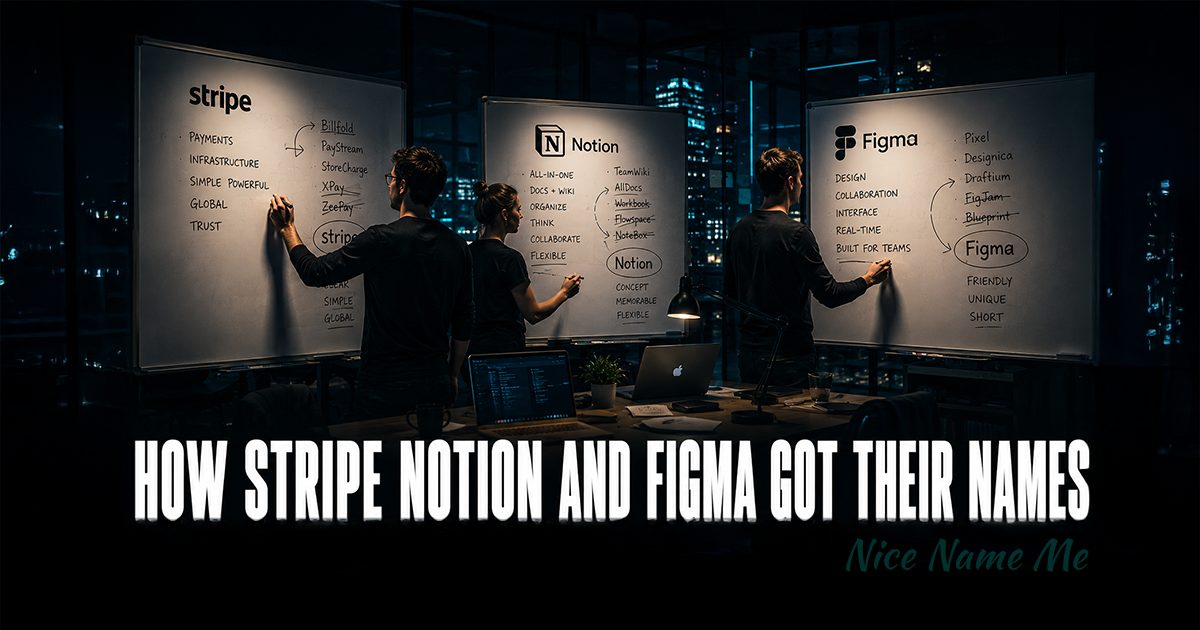
Stripe, Notion, and Figma collectively raised over $3 billion before any of them spent a dollar explaining what their names meant. That's not a coincidence — it's the outcome of naming decisions that prioritized function over cleverness, and clarity over creativity.
Most founders do the opposite. They chase abstract, invented, or metaphor-heavy names that require three sentences of context before a stranger understands the product. These three companies went the other direction, and the results speak for themselves.
Stripe: When One Word Does All the Work
Patrick and John Collison named their payment company Stripe in 2010. The word does something deceptively simple: it suggests clean, ordered lines — exactly the kind of systematic thinking that mattered to the developer audience they were courting first.
It's technical without being intimidating. It's visual without requiring a logo to explain it. And critically, it doesn't lock the company into a feature. Stripe doesn't say "payments" or "checkout" or "billing." It says something vaguer and more durable — organized structure, stripped-down efficiency.
That flexibility paid off. When Stripe expanded from payment processing into financial infrastructure, lending tools, and business incorporation, the name didn't fight the pivot. It absorbed it.
For AI tools, something like TagOn.ai follows the same logic — short, verb-adjacent, platform-agnostic.
There's a rebranding graveyard full of startups that named themselves after their first feature. Stripe named itself after a shape. The difference is ten years of relevance without a single identity crisis.
Notion: Naming for the Product You'll Build in Five Years
Notion launched publicly in 2016 with a product that was hard to categorize — part note-taker, part wiki, part database, part project manager. A narrower name would have been a trap.
"Notion" means an idea, a concept, a loose mental framework. It's the most deliberately open-ended name in this group. You can put anything inside a notion. That cognitive flexibility transferred directly to how users think about the product: you don't organize tasks in Notion, you build whatever system makes sense to you.
Compare that to "TaskBoard" or "NoteKeeper." Those names tell you exactly what the product does — and exactly where it stops. Notion's founders wanted breathing room, and the name gave it to them. By 2021, the company was valued at $10 billion, serving use cases nobody imagined at launch.
The word also travels well. "Notion" exists in French, Spanish, and Portuguese with nearly identical meaning. For a product targeting global knowledge workers, that's not a small thing — it's one fewer translation problem at every marketing touchpoint.
Understanding the psychology behind effective naming helps explain why this matters: names that carry existing meaning borrow credibility from the concept itself, rather than building associations from scratch.
Figma: Building New Mental Real Estate
Figma launched in 2016 with a browser-based design tool and a name that positioned it against nobody. "Figma" combines the root of "figure" — visual elements, shapes, forms — with a suffix that feels vaguely technical, slightly European, and entirely distinctive.
It doesn't say "design" directly. It doesn't invoke Photoshop or Illustrator. It creates its own category: this is where digital figures live. That positioning mattered enormously in a market dominated by Adobe tools with decades of brand equity. Figma didn't try to beat incumbents at their own naming game. It invented new terminology and won on different terrain.
Two syllables. Unambiguous pronunciation. No contested spelling. These factors determine whether teams actually say your product name in meetings or revert to "that design tool." Figma became default vocabulary at design teams worldwide because it was memorable enough to stick after one use.
Adobe acquired Figma in 2022 for $20 billion — a deal that was ultimately blocked by regulators, but the valuation confirmed that a two-syllable invented word had become one of the most valuable brand assets in software design.
The Three Rules These Names Share
Strip away the individual stories and a pattern emerges. These names work for three specific reasons, not general branding wisdom.
They describe behavior, not features. Stripe doesn't say "API." Notion doesn't say "notes." Figma doesn't say "vector." They describe what happens at a conceptual level — organizing, thinking, shaping — which keeps them accurate regardless of how the product evolves.
They survive spoken conversation. Word-of-mouth is still how most B2B tools spread inside organizations. Names that require spelling correction, cultural context, or a backstory to make sense create friction at the exact moment you want zero resistance. All three pass what you might call the "phone call test" — you can say them once, and the other person can look them up.
They leave room to grow. The startups that get trapped by their names usually named themselves after their launch product. These three named themselves after a broader idea, then built into it. That's not an accident of genius — it's a deliberate choice that most founders don't make early enough.
For a deeper breakdown of what separates sticky names from forgettable ones, the guide on what makes a brand name memorable covers the specific cognitive mechanisms at play.
What This Means When You're Choosing Your Name
The lesson isn't "find a metaphor and hope it sticks." The lesson is more specific: your name should describe a behavior or quality that remains true no matter how the product changes.
Ask yourself what's still true about your company at ten times your current scale. If the name you're considering stops making sense when you add a second product line, you're naming a feature, not a company.
Short words win. Unambiguous pronunciation wins. Cross-cultural legibility wins. These aren't opinions — they're the consistent properties of the names that became global defaults, from Stripe to Slack to Zoom.
If you're evaluating naming options, a domain appraisal can tell you which names already carry market value and which ones you'd be building equity in from zero. That gap is often larger than founders expect. Premium brandable domains in the domain store have already been filtered for the properties that matter — short, clear, pronounceable, extendable — which cuts weeks off a naming process that can otherwise stall a launch indefinitely.
When you've landed on the right name, register it immediately. Registrars like Dynadot offer competitive pricing and straightforward management without the upsell pressure that makes other registrars frustrating to use.
Stripe, Notion, and Figma didn't overthink their names. They found words that were honest about what they were building, flexible enough to grow, and simple enough to survive a conversation. Pick something that passes those three tests, buy the domain, and start building. The companies that win don't perfect their names — they make their names mean something.
Find Your Perfect Domain
Free three-tier appraisal — quick sale, realistic market, ideal buyer. No guesswork.
Try Free Appraisal Browse Premium Domains